viernes, 15 de marzo de 2019

pastperfeccont

Image result for past perfect continuous
The past perfect continuous (also called past perfect progressive) is a verb tense which is used to show that an action started in the past and continued up to another point in the past. Read on for detailed descriptions, examples, and present perfect continuous exercises.

Past Perfect Continuous Forms

The past perfect continuous is formed using had + been + present participle. Questions are indicated by inverting the subject and had. Negatives are made with not
  • Statement: You had been waiting there for more than two hours when she finally arrived.
  • Question: Had you been waiting there for more than two hours when she finally arrived?
  • Negative: You had not been waiting there for more than two hours when she finally arrived.

Past Perfect Continuous Uses

USE 1 Duration Before Something in the Past

past perfect continuous duration
We use the past perfect continuous to show that something started in the past and continued up until another time in the past. "For five minutes" and "for two weeks" are both durations which can be used with the past perfect continuous. Notice that this is related to the present perfect continuous; however, the duration does not continue until now, it stops before something else in the past.
Examples:
  • They had been talking for over an hour before Tony arrived.
  • She had been working at that company for three years when it went out of business.
  • How long had you been waiting to get on the bus?
  • Mike wanted to sit down because he had been standing all day at work.
  • James had been teaching at the university for more than a year before he left for Asia.
  • A: How long had you been studying Turkish before you moved to Ankara?
    B: I had not been studying Turkish very long.

USE 2 Cause of Something in the Past

past perfect continuous cause
Using the past perfect continuous before another action in the past is a good way to show cause and effect.
Examples:
  • Jason was tired because he had been jogging.
  • Sam gained weight because he had been overeating.
  • Betty failed the final test because she had not been attending class.

EXECISES
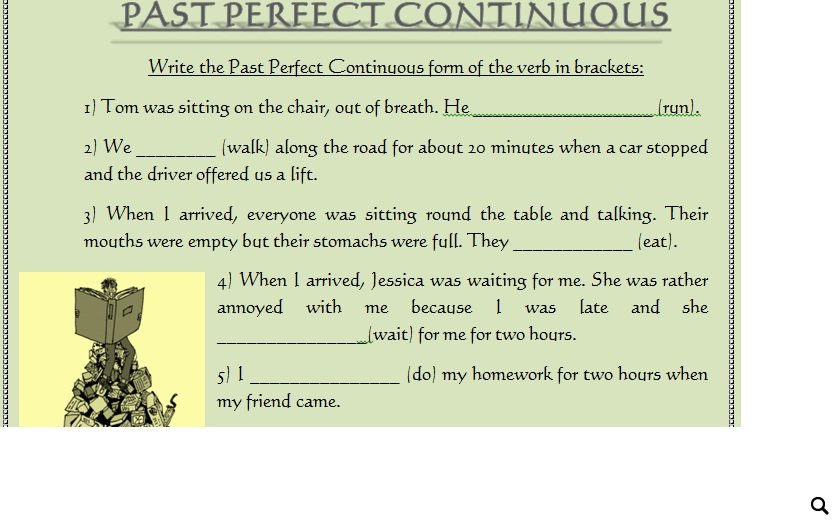
Put the verbs into the correct form (past perfect progressive).
  1. We (sleep)  for 12 hours when he woke us up.
  2. They (wait)  at the station for 90 minutes when the train finally arrived.
  3. We (look for)  her ring for two hours and then we found it in the bathroom.
  4. (not / walk)  for a long time, when it suddenly began to rain.
  5. How long (learn / she)  English before she went to London?
  6. Frank Sinatra caught the flu because he (sing)  in the rain too long.
  7. He (drive)  less than an hour when he ran out of petrol.
  8. They were very tired in the evening because they (help)  on the farm all day.
  9. (not / work)  all day; so I wasn't tired and went to the disco at night.
  10. They (cycle)  all day so their legs were sore in the evening.


viernes, 1 de marzo de 2019

pastperfect2

I.- Past or Past Perfect Tense – Simple: Fill in the correct form. 

1. Mary ___________________ (give) me Tony's address before she left.
 2. When the boys arrived at the cinema, the film ___________________ (already, start).
3. Before we reached the station we saw that we ___________________ (lose) our way.
4. All the tickets ___________________ (be) sold before the concert began.
5. They took a shower after they ___________________ (finish) the game.
6. I asked Mr Green how many books he ___________________ (read)
7. Mum asked me why I ___________________ (not tidy) up my room.
8. Bob was sorry that he ___________________ (told) me the story.
9. Alan watched TV after he ___________________ (have) lunch.
10. The sun ___________________ (shine) yesterday after it ___________________ (be) cold for many weeks.
11. Uncle David ___________________ (go) to the doctor after he ___________________ (be) ill for a month.
12. Before the police ___________________ (catch) the thief, he ___________________ (steal) two more watches.
13. Mum once ___________________ (paint) a picture although she ___________________ (never, learn) it.
14. I ___________________ (not tell) my teacher that my mum ___________________ (help) me with my homework.
15. I ___________________ (be) very angry when I ___________________ (see) that my brother ___________________ (eat) my apple.
16. The bike ___________________ (be) much more expensive than he ___________________ (think) at first.
 17. Dad ___________________ (drive) me home after I ___________________ (fall) into the water. 18. Marion ___________________ (ask) me what ___________________ (happen) to me last week. 19. We ___________________ (eat) two Big Macs before we ___________________ (go) home.
20. Paul ___________________ (not say) that he ___________________ (take) Albert's watch.
21. The days ___________________ (become) colder after it ___________________ (snow).
22. Martin ___________________ (tell) me that he ___________________ (be) in London.
23. I ___________________ (feel) great after I ___________________ (pass) the exam.
24. It ___________________ (be) Freddy who ___________________ (clean) the room.
 25. When I ___________________ (get) off the bike I ___________________ (see) that one of those tires ___________________ (lose) air.
26. I ___________________ (be) sorry that I ___________________ (not be) nicer to him.
27. Nobody ___________________ (come) to the meeting because Angela ___________________ (forget) to tell them about it.
28. I know that I ___________________ (see) her somewhere before.
29. Because she ___________________ (not check) the oil for so long, the car ___________________ (break) down.
30. She couldn't find the book that I ___________________ (lend) her.
31. They never ___________________ (never find) where he ___________________ (hide) the money.
 32. It was a firm that I ___________________ (never hear) of.
33. When she ___________________ (come ) in we all knew where she ___________________ (be)
34. The lesson ___________________ (already start) when I ___________________ (arrive).
 35. When I ___________________ (get) to the park I found out that I ___________________ (lose) my keys.
36. She told me that she ___________________ (work) in Germany.
37. When he ___________________ (paint) the kitchen he ___________________ (decide) to have a rest.
38. After I ___________________ (finish) the report, I saw that it ___________________ (be) too late.

II.- TRANSLATE THESE SENTENCES INTO SPANISH ON YOUR NOTEBOOK.


jueves, 28 de febrero de 2019

past perfect

We use the verb had and the past participle for the past perfect:
had finished the work.
She had gone .
The past perfect continuous is formed with had been and the -ing form of the verb:
had been finishing the work
She had been going.
The past perfect is used in the same way as the present perfect, but it refers to a time in the past, not the present.
We use the past perfect tense:
  • for something that started in the past and continued up to a given time in the past:
When George died he and Anne had been married for nearly fifty years.
She didn’t want to move. She had lived in Liverpool all her life.
We normally use the past perfect continuous for this:
She didn’t want to move. She had been living in Liverpool all her life.
Everything was wet. It had been raining for hours.
  • for something we had done several times up to a point in the past and continued to do after that point:
He was a wonderful guitarist. He had been playing ever since he was a teenager.
He had written three books and he was working on another one.
had been watching the programme every week, but I missed the last episode.
We often use a clause with since to show when something started in the past:
They had been staying with us since the previous week.
I was sorry when the factory closed. I had worked there since I left school.
I had been watching that programme every week since it started, but I missed the last episode.
  • when we are reporting our experience and including up to the (then) present:
My eighteenth birthday was the worst day I had ever had.
I was pleased to meet George. I hadn’t met him before, even though I had met his wife several times.
  • for something that happened in the past but is important at the time of reporting:
I couldn’t get into the house. I had lost my keys.
Teresa wasn’t at home. She had gone shopping.
We use the past perfect to talk about the past in conditionshypotheses and wishes:
I would have helped him if he had asked.
It was very dangerous. What if you had got lost?
I wish I hadn’t spent so much money last month.

1: A finished action before a second point in the past.
  • When we arrived, the film had started (= first the film started, then we arrived).
We usually use the past perfect to make it clear which action happened first. Maybe we are already talking about something in the past and we want to mention something else that is further back in time. This is often used to explain or give a reason for something in the past.
  • I'd eaten dinner so I wasn't hungry.
  • It had snowed in the night, so the bus didn't arrive.
If it's clear which action happened first (if we use the words 'before' or 'after', for example), the past perfect is optional.
  • The film started before we arrived / the film had started before we arrived.
2: Something that started in the past and continued up to another action or time in the past. The past perfect tells us 'how long', just like the present perfect, but this time the action continues up to a point in the past rather than the present. Usually we use 'for + time'. We can also use the past perfect continuous here, so we most often use the past perfect simple with stative verbs.
  • When he graduated, he had been in London for six years. (= He arrived in London six years before he graduated and lived there until he graduated, or even longer.)
  • On the 20th of July, I'd worked here for three months.
3: To talk about unreal or imaginary things in the past. In the same way that we use the past simple to talk about unreal or imaginary things in the present, we use the past perfect (one step back in time) to talk about unreal things in the past. This is common in the third conditional and after 'wish'.
  • If I had known you were ill, I would have visited you.
  • She would have passed the exam if she had studied harder.
  • I wish I hadn't gone to bed so late!
Put the verbs into the correct form (past perfect simple).
  1. The storm destroyed the sandcastle that we (build) .
  2. He (not / be)  to Cape Town before 1997.
  3. When she went out to play, she (do / already)  her homework.
  4. My brother ate all of the cake that our mum (make) .
  5. The doctor took off the plaster that he (put on)  six weeks before.
  6. The waiter brought a drink that I (not / order) .
  7. I could not remember the poem we (learn)  the week before.
  8. The children collected the chestnuts that (fall)  from the tree.
  9. (he / phone)  Angie before he went to see her in London?
  10. She (not / ride)  a horse before that day.

Complete the sentences below with the simple form of past perfect.

Example:He ____________ (leave) when I arrived.
He had left when I arrived.

1.I thought I knew her. I thought I  (see) her before.
2.He  (drive) only twice in his life before the accident.
3.Bonny no longer had her car. She  (sell) it.
4.I saw Annabel last week. She  (change) a lot.
5.Terry wasn't at home He  (just go) out.
6.I tried to find Mr Jones but he wasn't around. Then I found out he
 (die).
7.He didn't need to borrow the car because he  (have)
his bike repaired.
8.Jenny  (just get) home when the phone rang.
9.The new restaurant wasn't open any longer. It  (close) down.
10.He fed the cat because no-one  (feed) it for days.

Exercises

Put in the verbs in brackets into the gaps and form sentences in Past Perfect. Use contracted forms only when there are personal pronouns.


  1. She  in Sweden before she went to Norway. (to live)
  2. After we  the cornflakes, Henry came in. (to eat)
  3. Before Ken ran to Kerry's house, he  him. (to phone)
  4. After they  their rucksacks, they rode away on their bikes. (to pack)
  5. Gerry helped his grandma in the house because his father  him so. (to tell)
  6. The cat hid under the chair because the children  so loud. (to be)
  7. Before the students started to write, the teacher  their mobile phones. (to collect)
  8. After Max  his breakfast, he left the flat. (to finish)
  9. Laura repaired her glasses because her brother  them. (to break)
  10. By the time the show began, all friends (to arrive)

jueves, 14 de febrero de 2019

speculations

et's look at some other examples:
'Paul looks tired, he must have been out late last night.'
'I could have won the race if I had trained harder.'
'He might have gotten really sick if he hadn't started taking care of his health.'
'She may have taken the day off, because I haven't seen her today.
'I saw a strange light in the sky last night. It could have been a UFO!'
  • She looks sad. She must have ___ some bad news.


  • It might have ___ raining.


  • She must have already ___ my name.


  • He may have ___ them in his car.


  • The bird is gone, it must have ___ away.


  • He must have ___ himself after falling off his bike.


  • The sign is missing, they must have ___ it.


For each sentence, choose between can't, might or must to fill each space.

1. Your mother  be a great cook. You are always so keen to get back home to eat!
2. I don't know why I am so tired these days. I  be working too hard. Or maybe I am not sleeping too well.
3. Do you know where Carl is? He  be out - his car keys are on the table.
4. You seem to know everything about the theatre. You  go every week.
5. To give the promotion to Harold was silly. He  know much about this company after only a year working here.
6. Go and look in the kitchen for your gloves. They  be in there.
7. Oh, the phone is ringing. Answer it. It  be Kate. She always rings at this time.
8. Dan has been drinking that whiskey since early this afternoon. He be totally drunk by now.
9. That couple  think much of this film. They're leaving already - after only 20 minutes!
10. That's the second new car they have bought this year. They be very rich!

jueves, 24 de enero de 2019

zero conditional

1) Match the two parts of the zero conditional sentences. Then choose the correct words in italics.
1. If it rains / rained,                        a. they die / will die.
2. The engine starts /will start        b. if you have / had any problems
3. If I drink too much coffee            c. I take the tram to school.
4. I always watch comedies            d. if I felt / feel sad.
5. If plants don’t get water,             e. I get / will get a headache.
6. My teacher gets angry                f. if you turn the key.

7. Phone this number                      g. if I am / will be late for school.


2) Complete the zero conditional sentences with the correct form of the verbs in brackets.
1. If you ______________ water to 100° C, it ___________________. (heat, boil)
2. The menu_______________ on the screen if you ________________ this button twice. (appear, press)
3. Put those plants in the sun. If they _______________enough light, they ______________. (die, not get)
4. If you ______________ the right password, you __________________the website. (not have, not access)
5. My mum __________________well if she __________________coffee before bed. (not sleep, drink).
6. _________your teacher __________annoyed if you_________________ your homework? (get, not do)


3) Complete the zero conditional sentences by choosing the correct pairs of verbs from the box. Put the verbs in the correct form.
  feel/not do        be/play       not wake/not get      cannot/read       get/make         not remember/tell
  
1. If I ________________________to do my homework, I __________________ the teacher a lie.
2. If I __________________ my brother up in the morning, he _______________to school on time.
3. I ____________________music really loudly if I______________ at home alone.
4. If I ____________________sleep at night, I ___________________ a magazine.
5. ______you ______­­­­ embarrassed if you __________ a mistake when speaking English?
6. She _______________ her homework if she _________________ tired.